


What UX maturity really means in SaaS
UX maturity as an organizational capability
UX maturity describes how deeply user-centred thinking is embedded into an organization’s structure, processes, and culture. Rather than focusing only on interface quality, mature organizations integrate user insight into prioritisation, planning, and strategic trade-offs [3].
Research and practitioner models show that higher levels of UX maturity are characterised by leadership sponsorship, cross-functional collaboration, and systematic use of user evidence. At this stage, UX is no longer a downstream activity but a core input into strategy and risk management [4][5].
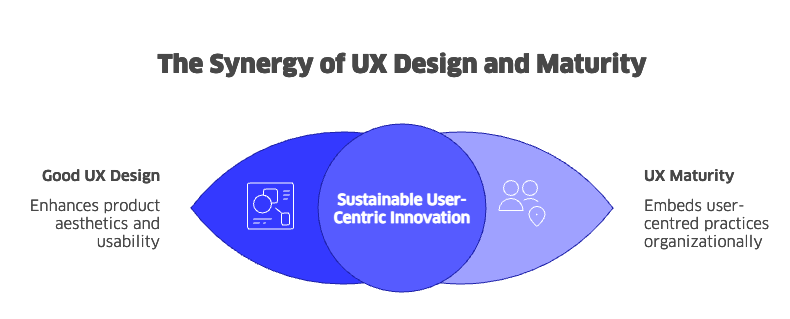
UX maturity vs good UX design
Good UX design improves how a product looks or feels at a specific point in time. UX maturity ensures that user-centred practices continue as teams grow, systems become more complex, and markets evolve.
In lower-maturity organizations, design often enters too late in the development process. This increases the risk of building features that are technically sound but poorly adopted. More mature teams use UX as an early validation layer, helping ensure that engineering effort is aligned with real user needs before significant investment is made [4][6].
Why UX maturity impacts SaaS business outcomes
Experience quality and value delivery
User experience directly affects whether users can complete key tasks and understand how a product creates value. Experience-led growth research shows that organizations treating experience as a core capability achieve stronger engagement and revenue performance over time [1][2].
When experience quality degrades, adoption often suffers even as functionality expands. Product benchmarks indicate that a significant share of shipped functionality is rarely used, adding complexity without increasing value [7][8]. UX maturity helps teams focus on solving meaningful user problems rather than accumulating features.
UX capability as a growth driver
Companies that invest in experience as an organizational capability consistently outperform competitors.Research from leading management consultancies shows that experienced leaders can achieve more than double the revenue growth of laggards over multi-year periods [1][2].
This gap highlights experience quality as a structural growth driver rather than a cosmetic improvement. UX maturity enables this by making experience quality repeatable and scalable across products and teams.
When UX maturity becomes essential in SaaS
In early-stage SaaS products, speed and experimentation are often prioritised. As products scale and competitors reach feature parity, experience quality becomes a more meaningful differentiator [1].
UX maturity becomes especially important when:
- User roles and workflows expand, increasing cognitive load
- Products serve broader or less specialised audiences
- Support effort grows due to usability friction
In these contexts, structured UX practices help reduce complexity and support more predictable growth by aligning teams around user outcomes rather than output volume [7][8].
How to assess UX maturity objectively
Assessing UX maturity requires more than intuition. UX maturity frameworks evaluate how consistently organizations apply user-centred practices across leadership, processes, and outcomes.
Common assessment dimensions include:
- Leadership sponsorship and accountability.
- Integration of user research into product planning.
- Cross-functional collaboration between product, design, and engineering.
- Use of UX evidence to guide prioritisation and trade-offs [3][5].
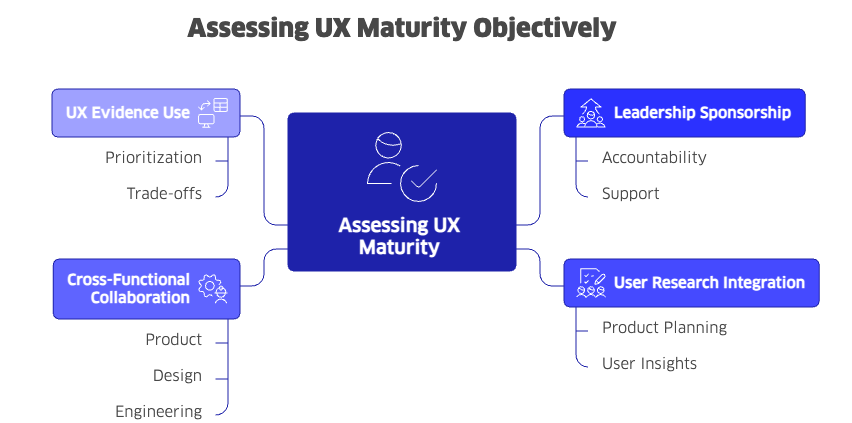
This allows leadership teams to understand not just UX quality, but UX capability.
UX metrics that matter to senior leaders
Executives need UX metrics that connect experience quality to real user outcomes.
Effective UX measurement focuses on whether users can complete important tasks, how quickly they reach value, and whether they return over time. Product benchmarks show that strong early activation is closely linked to long-term retention [7][9].
Combining behavioural data with qualitative insight helps leadership teams understand not only what is happening, but why it is happening. This supports clearer decision-making and reduces uncertainty when prioritising product investments [3][9].
UX research as a risk-reduction practice
A common concern among CTOs is that UX research slows development. A more accurate framing is to view UX research as a risk-reduction and decision-quality practice.
Research on SaaS UX maturity shows that when design and user validation enter late, organizations face higher levels of rework, design debt, and wasted engineering effort [4][8]. In contrast, involving users earlier helps teams surface usability and adoption risks before decisions are locked in.
This does not guarantee faster delivery. It reduces uncertainty and improves the quality of decisions made under increasing product complexity [4][8].
Organizational conditions required for UX maturity
UX maturity depends on leadership and organizational culture, not just tools or headcount.
Research on UX maturity and culture shows that without executive sponsorship and shared accountability, UX initiatives struggle to influence outcomes. Where leadership actively supports UX practices, teams demonstrate stronger collaboration, clearer ownership, and better alignment around user value [3][5].
This reinforces UX maturity as a management challenge rather than a design problem.
How UX maturity improves product and technical decisions
Mature UX practices help teams prioritise based on evidence rather than assumptions. This leads to clearer roadmaps, fewer late-stage surprises, and more transparent trade-offs.
Research on feature overload and design debt suggests that organizations with stronger UX foundations avoid compounding complexity and are better positioned to scale systems without sacrificing usability or team efficiency [7][8].
For technical leaders, UX maturity provides earlier visibility into user risks and constraints, supporting more deliberate planning as products and architectures evolve.
Why does UX maturity define the success of modern SaaS products?
UX maturity determines whether a SaaS organization can scale learning alongside features. It enables teams to manage complexity, align decisions around user value, and sustain growth as products evolve.
For senior leaders, the takeaway is clear. UX maturity is not a design initiative. It is an operating model that supports clarity, execution, and long-term performance.
At Mosano, we help SaaS companies assess UX maturity, align product and engineering teams, and translate user insight into scalable execution. If you want to understand where your product stands, get in touch to start the conversation.
References
[1] McKinsey & Company, Experience-led growth: A new way to create value (2023)
[2] Boston Consulting Group, Don’t Just Improve Your Customer Experience. Future-Proof It. (2023)
[3] Interaction Design Foundation, What is UX Maturity? (updated 2024)
[4] Célestin Lebéhot, UX Maturity: Is Your SaaS “Just Pretty” or Truly Strategic? (2025)
[5] Indeed Design, Why UX maturity and culture matter (2024)
[6] UX Magazine, 10 Reasons Why UX Maturity Matters (2023)
[7] OpenView, 2023 Product Benchmarks Report
[8] SaaSFactor, Function-First Design: Why B2B SaaS Wins on Usability, Not Aesthetics (2025)
[9] Freshworks, The ROI of Great UX (2023)